Assignments Involving CSTR Analysis
Examples from REB, The Book
Example 6.6.1 The amount of A, (10%), in a gas mixture with B (65%), and inert, I, (25%) at 165 °C and 5 atm needs to be reduced to 0.1%. This is going to be accomplished by converting the A into Z according to reaction (1). An adiabatic CSTR is going to be used. The rate expression is given in equation (2) where the pre-exponential factor is 1.37 x 10⁵ m3 mol-1 min-1 and the activation energy is 11,100 cal mol-1. The heat of reaction is constant and equal to -7200 cal mol-1, and the heat capacities of A, B, I, and Z are equal to 7.6, 8.2, 4.3, and 13.8 cal mol-1 K-1, respectively. What space time is required, and what temperature will result?
\[ A + B \rightarrow Z \tag{1} \]
\[ r_1 = k_1C_AC_B \tag{2} \]
Example 6.6.1 Calculations using Python
Example 6.6.1 Calculations using Matlab
Example 6.6.2 Reactants A and B can react irreversibly to produce either a desired product, D, or an undesired product, U, as shown in equations (1) and (2). The rate expressions for reactions (1) and (2) are given in equations (3) and (4), respectively. In those rate expressions, the pre-exponential factors for \(k_1\) and \(k_2\) are 10.2 gal mol-1 min-1 and 17.0 gal mol-1 min-1, respectively, and the activation energies are 15.3 kJ mol-1 and 23.7 kJ mol-1, respectively. A liquid mixture containing 10 mol A gal-1 and 12 mol B gal-1 at 350 K is fed to an adiabatic 25 gal CSTR at a rate of 12.5 gal min-1. If the standard heats of reactions (1) and (2) at 298 K are -12.0 and -21.3 kJ mol-1, respectively, and if the reagents form an ideal liquid mixture with the temperature-independent heat capacities of A, B, D and U equal to 85, 125, 200 and 170 J mol-1 K-1, what are the conversion of the limiting reagent, the outlet selectivity (in mol D per mol U) and the outlet temperature?
\[ A + B \rightarrow D \tag{1} \]
\[ A + B \rightarrow U \tag{2} \]
\[ r_1 = k_1 C_AC_B \tag{3} \]
\[ r_2 = k_2 C_AC_B \tag{4} \]
Example 6.6.2 Calculations using Python
Example 6.6.2 Calculations using Matlab
Example 6.6.3 To produce Z via reaction (1), reagent A will be fed to an adiabatic 0.5 m3 CSTR at 70 mol min-1, and B will be fed at 1500 mol min-1 giving a total liquid feed rate of 40 L min-1. The rate expression for reaction (1) is given in equation (2), where the pre-exponential factor for the rate coefficient is 1.2 x 10⁹ m3 mol-1 min-1 and the activation energy is 25.8 kcal mol-1. The equilibrium constant appearing in the rate expression can be calculated using equation (3), where the pre-exponential factor is 4.2 x 10⁻¹⁸ m3 mol-1 and the heat of reaction is -22.4 kcal mol-1. The heat capacities of A, B, and Z are 412, 75.5, and 512 J mol-1 K-1, respectively, and may be taken to be independent of temperature. What feed temperature will maximize the conversion of A?
\[ A + B \rightarrow Z \tag{1} \]
\[ r_1 = k_1C_AC_B\left( 1 - \frac{C_Z}{K_1C_AC_B}\right) \tag{2} \]
\[ K_1 = K_{0,1}\exp{\frac{-\Delta H_1}{RT}} \tag{3} \]
Example 6.6.3 Calculations using Python
Example 6.6.3 Calculations using Matlab
Example 6.6.4 An adiabatic, steady-state CSTR with a volume of 500 cm3 is going to be used to convert A and B into Y and Z according to reaction (1). A liquid solution flowing at 1.0 cm3 s-1 and containing equal amounts of A and B (0.015 mol cm-3) at 50 °C will be used. The heat capacity of the fluid is essentially equal to that of the solvent, 0.35 cal g-1 K-1 and can be considered to be constant. The density of the fluid, also constant, is 0.93 gm cm-3. The rate expression for reaction (1) is given in equation (2), and the heat of reaction (1) may be assumed to be constant and equal to -20 kJ mol-1. The rate coefficient displays Arrhenius temperature dependence with a pre-exponential factor equal to 3.24 x 1012 cm3 mol-1 s-1, and an activation energy of 105.0 kJ mol-1. How many steady states are possible at these conditions, and what are the conversion and outlet temperature for each of them?
\[ A + B \rightarrow Y + Z \tag{1} \]
\[ r_1 = k_1C_AC_B \tag{2} \]
Example 6.6.4 Calculations for Multiplicity Plot using Python
Example 6.6.4 Calculations for Multiplicity Plot using Matlab
Example 6.6.4 Calculations for Steady States using Python
Example 6.6.4 Calculations for Steady States using Matlab
Example 6.6.5 A 10 gal CSTR with a 1.25 gal shell is going to be used for the conversion of A and B according to reactions (1), (2), and (3). Both the reactor and the shell are perfectly mixed. Before flow into the reactor begins, it is full and contains a solution containing only B at a concentration of 3 mol gal-1 and a temperature of 20 °C, while the shell contains cooling water at 20 °C. To start up the reactor, 0.5 gal min-1 of a feed consisting of a liquid solution of A (7.5 mol gal-1) and B (3 mol gal-1) at 50 °C starts flowing into the reactor and simultaneously cooling water at 20 °C starts flowing into the shell at a rate of 250 g min-1. The heat transfer coefficient between the reactor and the shell is 190 cal ft-2 min-1 K-1 and the heat transfer area is 4 ft2. The entire process operates at a constant pressure of 1 atm.
\[ A + B \rightarrow W + Z \tag{1} \]
\[ A + B \rightarrow X + Z \tag{2} \]
\[ A + B \rightarrow Y + Z \tag{3} \]
Each of the reactions is first order in the concentration of A and first order in the concentration of B. The pre-exponential factors, activation energies and heats of reaction are listed in the table below. The heats of reaction may be taken to be constant. The cooling water has a constant density of 1 g cm-3 and a constant heat capacity of 1 cal g-1 K-1. The reacting fluid may be assumed to have a constant heat capacity of 1600 cal gal-1 K-1.
Plot the temperature of the reacting fluid, the temperature of the cooling water in the jacket, and the concentration of B in the reactor during the first 30 minutes of the start-up process.
| Reaction | k0 (gal mol-1 min-1) | E (kcal mol-1) | \(\Delta H\) (kcal mol-1) |
|---|---|---|---|
| 1 | 4.3 x 10⁸ | 14.2 | -11.0 |
| 2 | 2.7 x 10⁸ | 16.1 | -11.6 |
| 3 | 3.9 x 10⁸ | 14.8 | -12.1 |
Example 6.6.5 Calculations using Python
Example 6.6.5 Calculations using Matlab
Example 6.6.6 Example 6.6.4 showed conditions where three steady states are possible when reaction (1) takes place in an adiabatic CSTR. Specifically, the reactor volume is 500 cm3 and the feed is 1.0 cm3 s-1 of a solution containing 0.015 mol cm-3 each of A and B at 50 °C. The heat capacity is 0.35 cal g-1 K-1, and the density is 0.93 gm cm-3. The heat of reaction is -20 kJ mol-1, and the rate is given by equation (2) with the pre-exponential factor equal to 3.24 x 1012 cm3 mol-1 s-1 and the activation energy equal to 105.0 kJ mol-1. The steady-state conversions were 0.03, 39.9, and 97.5%, and the corresponding outlet temperatures were 50, 183, and 265 °C.
\[ A + B \rightarrow Y + Z \tag{1} \]
\[ r_1 = k_1C_AC_B \tag{2} \]
The outlet temperature for this reactor was plotted as a function of the feed temperature , and that graph is reproduced here as Figure 1, with three steady states labeled “Shigh,” “Umid,” and “Slow” Steady states Shigh (97.5% conversion) and Slow (0.03% conversion) are stable while steady state Umid (39.3% conversion) is unstable.
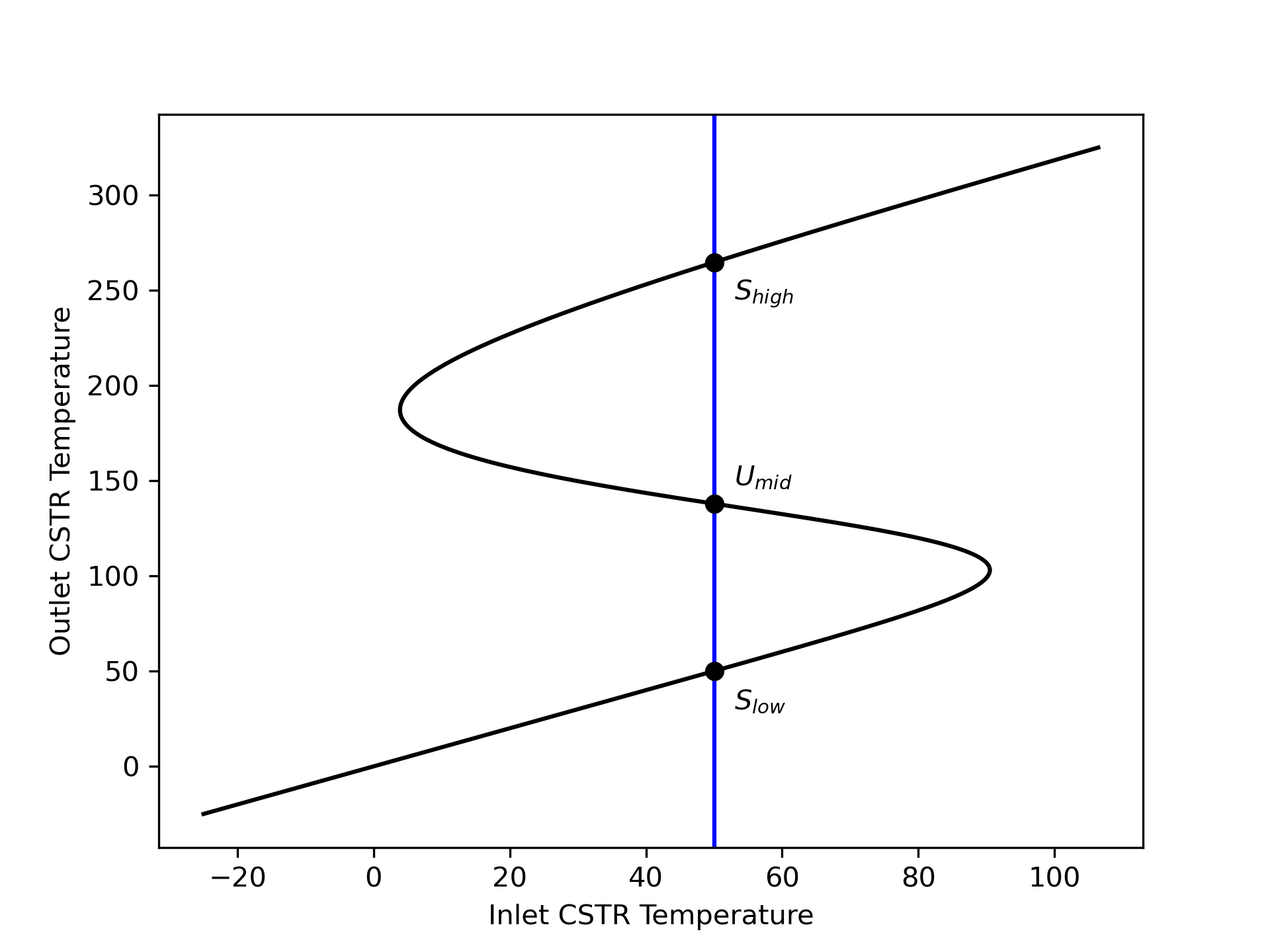
To show that steady state Umid is unstable, plot the outlet temperature vs. time if the temperature of a CSTR at steady state Umid is perturbed +1 °C, and by -1 °C holding all of the inputs constant. To show the two other steady states are stable, plot the outlet temperature vs. time if the temperature of a CSTR at each of those steady states is perturbed +20 °C, and by -20 °C holding all of the inputs constant.
Learning Activities from REB, The Course
Learning Activity 9 A 150°C solution containing 2 mol L–1 of A is being fed to a 500 L CSTR at a rate of 250 L h–1. A jacket surrounding the CSTR contains molten salt at a constant temperature of 180 °C. The contact area between the CSTR contents and the jacket is 2 m2 and the overall heat transfer coefficient is equal to 500 kcal m–2 h–1 K–1. Within the reactor reaction (1) occurs at a rate given by equation (2). The pre–exponential factor for the rate coefficient in equation (2) is 1.14 × 10⁹ L mol–1 h–1 and the activation energy is 16.2 kcal mol–1. The reacting solution has a constant density and a constant heat capacity of 1.17 cal ml–1 K–1. The heat of reaction is 18.2 kcal mol–1 and is independent of temperature. At steady state, what are the outlet temperature and conversion of A?
\[ A \rightarrow Z \tag{1} \]
\[ r_1 = k_1C_A^2 \tag{2} \]
Learning Activity 9 Calculations Using Python
Learning Activity 9 Calculations Using MATLAB
Learning Activity 10 An ideal, 50 gal CSTR is fed a liquid solution containing 0.014 lbmol A gal−1 and 0.020 lbmol B gal−1 at a temperature of 70 °F. The heat capacity of the reacting liquid is constant and equal to 65 BTU ft−3 °R−1. A jacket surrounding the reactor is supplied with saturated steam at 220 °F. The steam condenses in the jacket, leaving as a saturated liquid. The overall heat transfer coefficient is 60 BTU ft−2 °R−1 h−1, and the heat transfer area is 13 ft2. Reactions (1) and (2) take place within the steady-state CSTR. The heat of reaction (1) is 45,000 BTU lbmol−1, and the heat of reaction (2) is 39,500 BTU lbmol−1. The rate expressions for reactions (1) and (2) are given in equations (3) and (4). The rate coefficients obey the Arrhenius expression. For reaction (1) the pre-exponential factor is 1.6 × 10¹⁸ gal lbmol−1 h−1, and the activation energy is 46,000 BTU lbmol−1. For reaction (2) the pre-exponential factor is 4.5 × 10¹⁸ gal lbmol−1 h−1, and the activation energy is 54,000 BTU lbmol−1. What volumetric feed rate will maximize the rate of production of reagent D? At that feed rate, what is the conversion of A and the reactor temperature?
\[ A + B \rightarrow D + Z \tag{1} \]
\[ D + B \rightarrow U + Z \tag{2} \]
\[ r_1 = k_1C_AC_B \tag{3} \]
\[ r_2 = k_2C_DC_B \tag{4} \]
Learning Activity 10 Calculations Using Python
Learning Activity 10 Calculations Using Matlab
Learning Activity 11 Equal molar amounts of gases A and B flow into an adiabatic CSTR at 260 °C and 3 atm. The space time is 80 s. Reagent Z is generated according to reaction (1) which obeys the rate expression shown in equation (2). The rate coefficient exhibits Arrhenius temperature dependence. The pre-exponential factor is 1.26 x 10⁶ L mol–1 s–1 and the activation energy is 19 kcal mol–1. The heat of reaction (1) is –10.5 kcal mol–1, and the heat capacities of A, B, and Z are 42, 122, and 173 J mol–1 K–1. How many steady states are possible, and what are the conversion and outlet temperature for each of them?
\[ A + B \rightarrow Z \tag{1} \]
\[ r_1 = k_1C_AC_B \tag{2} \]
Learning Activity 11 Calculations for Multiplicity Plot using Python
Learning Activity 11 Calculations for Steady States using Python
Learning Activity 11 Calculations for Multiplicity Plot using Matlab
Learning Activity 11 Calculations for Steady States using Python
Learning Activity 12 Examples 6.6.4 and 6.6.6 from REB, The Book analyzed an adiabatic, steady-state CSTR with a volume of 500 cm3 that was going to be used to convert A and B into Y and Z according to reaction (1). A liquid solution flowing at 1.0 cm3 s–1 and containing equal amounts of A and B (0.015 mol cm–3) at 50 °C was going be used. The heat capacity of the fluid is essentially equal to that of the solvent, and can be considered to be constant and equal to 0.35 cal g–1 K–1. The density of the fluid, also constant, is 0.93 g cm–3. The rate expression for reaction (1) is given in equation (2), and the heat of reaction (1) may be assumed to be constant and equal to –20 kJ mol–1. The rate coefficient displays Arrhenius temperature dependence with a pre-exponential factor equal to 3.24 x 1012 cm3 mol–1 s–1, and an activation energy of 105.0 kJ mol–1.
Example 6.6.4 showed that three steady states are possible for this reactor, and Example 6.6.6 showed that the high temperature (265 °C) and low temperature (50.1 °C) steady states are stable while the steady state at 138 °C is unstable. One possible startup procedure for this reactor is to fill it with pure solvent, heat the solvent to some initial temperature, and then initiate the feed flow. Compare the transient outlet temperature vs. time for initial temperatures of 180 °C and 190 °C.
\[ A + B \rightarrow Y + Z \tag{1} \]
\[ r_1 = k_1C_AC_B \tag{2} \]
Learning Activity 12 Calculations using Python
Learning Activity 12 Calculations using Matalb
Learning Activity 13 Cells are growing in an isothermal, steady-state CSTR. The effective reaction, in mass units, is given in equation (1). The reaction is auto-catalytic, and the rate is accurately described by the Monod equation, equation (2), with equal to 0.014 min–1 and equal to 0.001 g cm–3. Through an appropriate startup process, the 4.43 L reactor can operate at steady-state with no cell mass in the feed. Specifically, if 60 cm3 min–1 of feed containing only substrate at a concentration of 0.04 g cm-3, the steady-state product stream contains substrate at a concentration of 2.97 x 10⁻² g cm–3 and cell mass at at concentration of 4.68 x 10⁻³ g cm–3. However, reactor operation is parametrically sensitive to the volumetric flow rate. Show that to be true by calculating the transient outlet concentration of cell mass as a function of time if the inlet volumetric flow rate changes from 60 to 61 cm3 min–1.
\[ 2.2 \, S \rightarrow X \tag{1} \]
\[ r_1 = \frac{V_{max}\left[S\right]\left[X\right]}{K_m + \left[S\right]} \tag{2} \]
Practice Assignments from REB, The Course
Practice Assignment 9 The rate of liquid-phase reaction (1) is adequately described by the rate expression given in equation (2). The rate coefficients exhibits Arrhenius temperature dependence with a forward pre-exponential factor of 1.93 x 1013 ft3 lbmol–1 min–1, a reverse pre-exponential factor of 2.86 x 1026 min–1, a forward activation energy of 46,400 BTU lbmol–1, and a reverse activation energy of 86,700 BTU lbmol–1. The heat of reaction (1) is constant and equal to –40,300 BTU lbmol–1.
Reactant A is fed to a steady state CSTR at a rate of 0.015 lbmol min–1, and reactant B is fed at a rate of 3.3 lbmol min–1. This corresponds to an inlet volumetric flow rate of 1.41 ft3 min–1. The CSTR has a fluid volume of 18 ft3, and it operates adiabatically. The heat capacity of reagent A is 100 BTU lbmol–1 °R–1, that of B is 18 BTU lbmol–1 °R–1, and the heat capacity of Z is 120 BTU lbmol–1 °R–1, and they may be considered to be independent of temperature. What will the conversion and outlet temperatures equal if the combined feed enters at 200 °F.
\[ A + B \rightleftarrows Z \tag{1} \]
\[ r_1 = k_{1,f}C_AC_B\ - k_{1,r}C_Z \tag{2} \]
Practice Assignment 9 Solution
Practice Assignment 9 Calculations using Python
Practice Assignment 9 Calculations using Matlab
Practice Assignment 10 A 4 L CSTR is being used to convert A to Z according to reaction (1). The rate expression for reaction (1) is given in equation (2). The rate coefficient obeys the Arrhenius expression with a pre-exponential factor equal to 2.59 x 10⁹ min–1 and an activation energy equal to 16,500 cal mol–1. The heat of reaction (1) may be taken to be constant and equal to –22,200 cal mol–1. The heat capacity of the reacting solution is approximately constant and equal to 440 cal L–1 K–1, and its density is constant. The reactor has a jacket with a volume of 0.5 L, a heat transfer area of 0.6 ft2 and a heat transfer coefficient of 5.65 x 10³ cal ft–2 h–1 K–1. The cooling water may be taken to have a constant density of 1 g cm–3 and a constant heat capacity of 1 cal g–1 K–1.
The feed is a solution containing only A at a concentration of 2M and a temperature of 60 °C, and cooling water at 20 °C flows into the jacket at 0.2 kg min–1. Compare the conversion, outlet temperature, and outlet coolant temperature for space times of 50 and 60 min.
\[ A \rightarrow Z \tag{1} \]
\[ r_1 = k_1C_A \tag{2} \]
Practice Assignment 10 Solution
Practice Assignment 10 Calculations
Practice Assignment 11 Suppose a steady state, 500 ml CSTR operates adiabatically at a space time of 0.4 min. The liquid feed concentration is 5 M, and the feed temperature is 60 ºC. The fluid heat capacity is constant and equal to 1 cal ml–1 K–1. In the reactor the feed, A, is converted to Z, reaction (1). The heat released by the reaction is 30 kcal mol–1. The reaction rate is first order in A, equation (2), with a pre-exponential factor of 4.75 x 10¹³ min–1 and an activation energy of 25 kcal mol–1. Determine how many steady states are possible at these conditions and the conversion and outlet temperature for each of them.
\[ A \rightarrow Z \tag{1} \]
\[ r_1 = k_1C_A \tag{2} \]
Practice Assignment 11 Solution
Practice Assignment 11 Multiplicity Calculations using Python
Practice Assignment 11 Steady-State Calculations using Python
Practice Assignment 11 Multiplicity Calculations using Matlab
Practice Assignment 11 Steady-State Calculations using Matlab
Practice Assignment 12 Liquid phase reaction (1) takes place in an adiabatic CSTR with a volume of 1.5 L operating at atmospheric pressure. The 50 °C feed to the reactor is 1.5 M in A and 2.5 M in B. The kinetics are given by equation (2) with k0,1 = 1.4 x 10¹⁴ min–1 and E1 = 22 kcal mol–1. The heat of reaction is –211 kJ mol–1, and the heat capacity of the fluid is 1.3 cal cm–3 K–1. The reactor is going to be started up at a space time of 10 min by initially filling it with solvent (no reactants or products) at 50 °C and then starting the feed flow. Calculate and plot the outlet molar flow of Y and the outlet temperature as functions of time.
\[ 2 \, A + B \rightleftarrows 2 \, Y + 2 \, Z \tag{1} \]
\[ r_1 = k_1C_A \tag{2} \]
Practice Assignment 12 Solution
Practice Assignment 12 Calculations using Python
Practice Assignment 12 Calculations using Matlab
Practice Assignment 13 A jacketed, 17.7 ft3 CSTR is operating at steady state. A liquid solution containing only reagent A at a concentration of 0.125 lbmol ft–3 is flowing into the reactor at 0.15 ft3 min–1, 300 °F, and 1 atm. The reacting solution is incompressible and has a constant heat capacity of 73.1 BTU ft–3 °F–1. Reaction (1) is taking place within the CSTR at a rate given by equation (2) where the rate coefficient pre-exponential factor is 3.04 × 108 ft3 lbmol–1 min–1 and the activation energy is 29,100 BTU lbmol–1. The heat of reaction is 32,800 BTU lbmol–1 and is independent of temperature. A heat exchange fluid with a density of 81.2 lbm ft–3 and a heat capacity of 1.06 BTU lbm–1 °F–1 flows into the jacket at 15 lbm min–1 and 410 °F. The heat exchange fluid leaves the jacket at 355 °F. The jacket volume is 7 ft3, the heat transfer area is 21.5 ft2 and the overall heat transfer coefficient is equal to 1.71 BTU ft–2 min–1 °F–1. The steady-state conversion of A is 85.3% and the steady-state outlet temperature is 332 °F. Suppose that an equipment failure elsewhere in the chemical plant caused the exchange fluid flow rate to instantaneously drop to a constant value of 5 lbm min–1. Plot the outlet concentration of Z and the reacting fluid temperature over the next 10 h assuming all other reactor inputs are unaffected.
\[ A \rightarrow Z \tag{1} \]
\[ r_1 = k_1C_A^2 \tag{2} \]
Practice Assignment 13 Solution
Additional Assignments for Extra Practice
Additional assignments will be added as they become available.
This website is licensed under the Creative Commons Attribution-Non-Commercial-NoDerivatives 4.0 International License (CC BY-NC-ND 4.0).